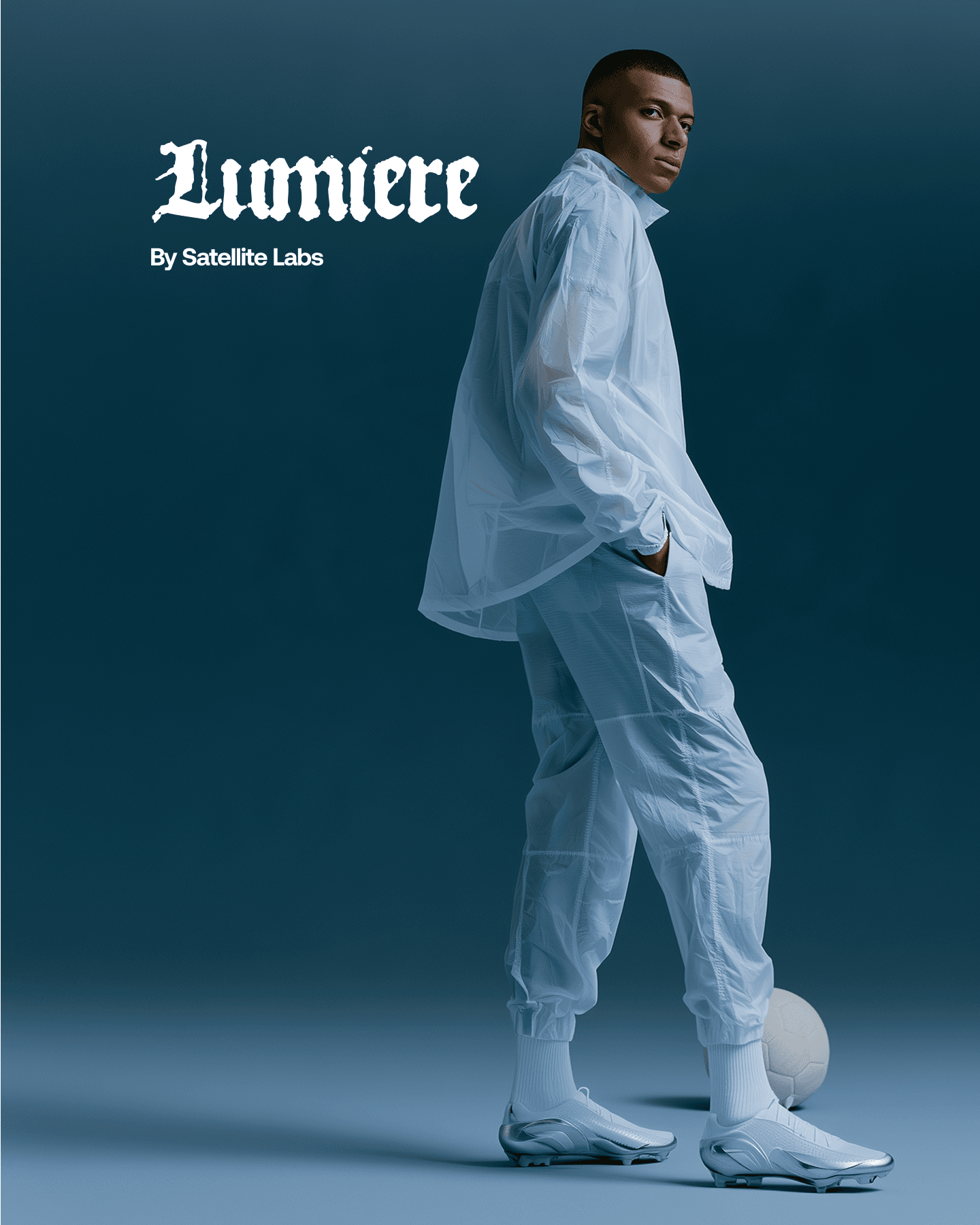

In September, Kylian Mbappé shocked the football world and announced that he was leaving Nike. He had been with the company since he was nine years old, a relationship that lasted nearly two decades and followed him from his days as a prodigious kid in the Paris suburbs to becoming captain of France and one of the most recognisable athletes on the planet.
But he didn't leave Nike for Adidas or Puma. He left for On, the Swiss running brand that barely existed when Mbappé first put on a pair of Nike boots. The reason he gave was telling. He said he wanted the opportunity to “build something entirely new.” Perhaps there is an irony in one of the world's biggest athletes leaving Nike in search of the future, because for most of its history, showing us the future was exactly what Nike did best.
And Mbappé's departure isn't the only recent sign that something at Nike has changed. That same month, Nike was removed from the S&P 100 after 18 years in the index, following a dramatic decline in its market value from its 2021 peak. Its position in the Dow Jones Industrial Average has come under scrutiny too. On the pitch, the losses have been just as symbolic. Nike lost Lamine Yamal, arguably the brightest young star in world football, to Adidas. In 2025, it also lost the Premier League match ball contract it had held for more than two decades, this time to Puma. And now Mbappé, the player Nike had increasingly positioned as an heir to Cristiano Ronaldo, is gone too.
Individually, none of these things means Nike is finished. It remains one of the biggest sportswear companies in the world, sponsors some of its greatest athletes and teams, and still possesses perhaps the most recognisable symbol in sport. But taken together, they point towards something harder to ignore. Nike doesn't seem as inevitable as it once did. For most of the last four decades, Nike was the company everyone else was chasing. Today, it increasingly finds itself doing the chasing.
In this essay, we're going to get into what happened. Why did Nike stop winning?
1. How Nike Won
There was a time when Nike seemed to have an almost uncanny ability to predict what sport would look like next. In 1984, it took a chance on a 21-year-old rookie called Michael Jordan and, rather than simply paying him to wear its shoes, built an entire brand around him. Three years later, Air Max made the technology inside a running shoe visible from the outside. In 1998, the Mercurial arrived on the feet of Ronaldo Nazario at the World Cup, built specifically for a new kind of faster, more explosive footballer. Then came Tiger Woods, Kobe Bryant, Cristiano Ronaldo, Flyknit, Vaporfly and a succession of products, athletes and campaigns that seemed to arrive just as culture was moving towards them.
What made Nike so difficult to compete with was that these things rarely existed in isolation. Product innovation, athletes and storytelling worked together. Michael Jordan made the shoes more desirable, but the shoes also made Jordan feel larger than basketball. New technology gave Nike something new to talk about, while its advertising gave that technology meaning beyond its specifications. A Nike product wasn't simply presented as a better version of what already existed. At its best, it felt like a glimpse of what was coming next.
That ability extended beyond products. Nike understood that the athletes shaping the future of sport could also shape culture beyond it. Michael Jordan became a global icon. Andre Agassi made tennis rebellious. Tiger Woods changed the face of golf. Ronaldo made the Mercurial part of a new, faster and more expressive era of football. Nike wasn't simply attaching its logo to whoever was already famous. It was identifying the people, products and ideas that might define the next era, then helping make them famous.
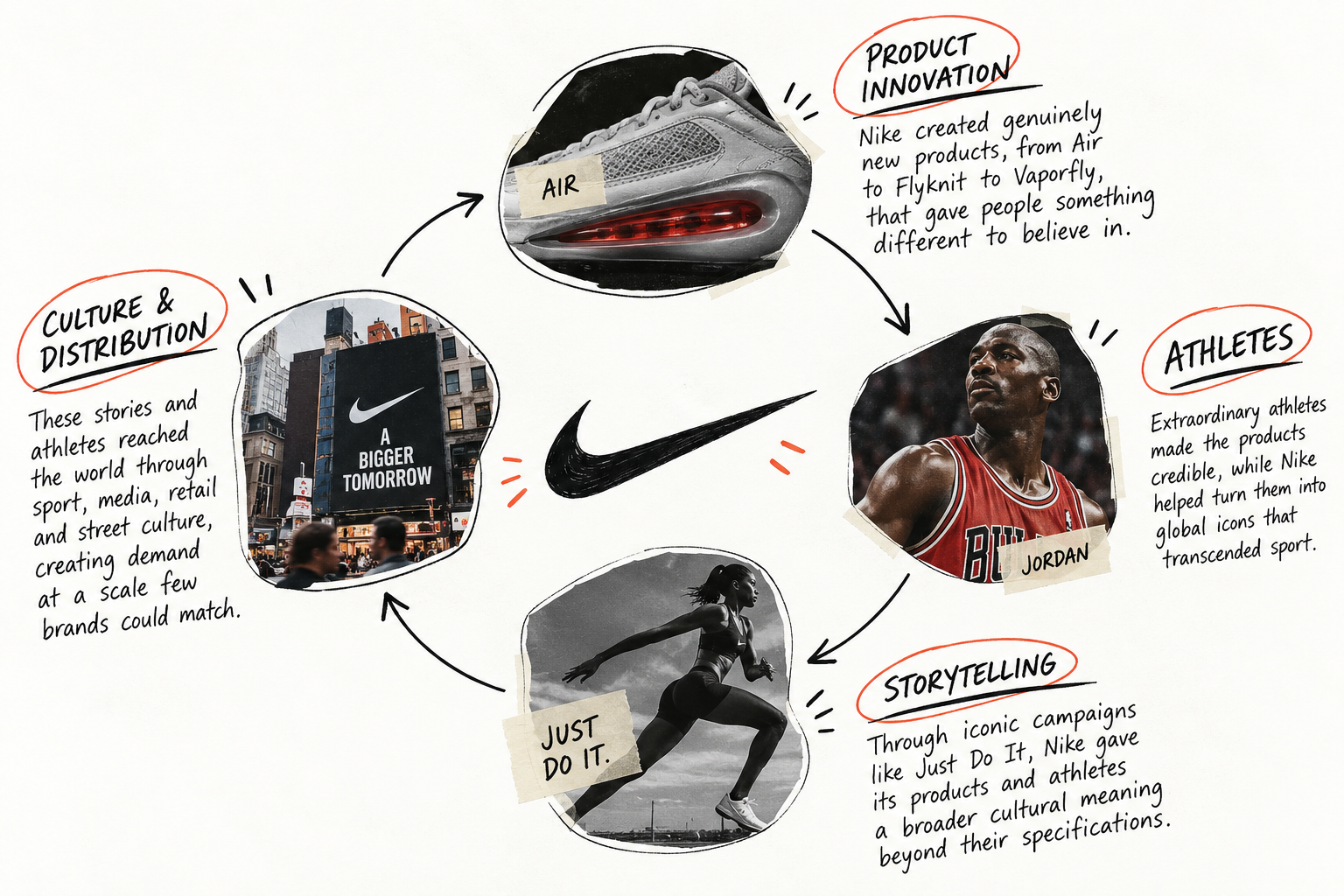
And perhaps that is the simplest way to understand the Nike that dominated sport for decades. Nike didn't win by reminding us how good Nike had been. It won by making us excited about what was coming next.
Which makes what happened next all the more interesting.
2. Nike started selling us the past
Somewhere along the way, Nike's relationship with the future began to change. The company that had built its reputation by constantly introducing us to what came next became increasingly good at selling us what had come before.
Look at some of the shoes that have defined Nike's cultural relevance over the last decade. The Air Force 1 was first released in 1982. The Air Jordan 1 arrived in 1985. The Air Max 1 in 1987. The Dunk, another silhouette that became almost impossible to avoid at the height of sneaker culture, first appeared in 1985. Even as Nike continued to develop genuinely new products, many of the shoes generating the most attention were designs that were already decades old.
For a while, this worked extraordinarily well. Nike possesses perhaps the greatest archive in sportswear, and a new generation discovering an old shoe can make that shoe feel new again. Collaborations, limited releases and new colourways turned familiar silhouettes into objects of desire. The resurgence of the Dunk was so powerful that a basketball shoe designed in the 1980s became one of the defining fashion products of the early 2020s.
Then there was Michael Jordan.
In 2020, The Last Dance introduced Jordan's story to a generation that had never watched him play. More than two decades after his final championship with the Chicago Bulls, millions of people were suddenly watching Jordan's mythology unfold again. Demand, of course, followed. The documentary helped reignite interest in Jordan sneakers at precisely the moment when sneaker culture was exploding into the mainstream.
But there is a limit to how many times a brand can rediscover its own past.
Michael Jordan is now 63 years old. His final championship with the Bulls was 28 years ago. Even The Last Dance, itself an exercise in looking backwards, aired six years ago. A teenager buying their first pair of sneakers today isn't remembering Michael Jordan playing basketball. They are inheriting the memory of someone else's cultural moment. And this articulates the difference between heritage and nostalgia. Heritage gives a brand the foundation on which to build something new. Nostalgia asks the past to keep doing the work of maintaining relevance in the present.
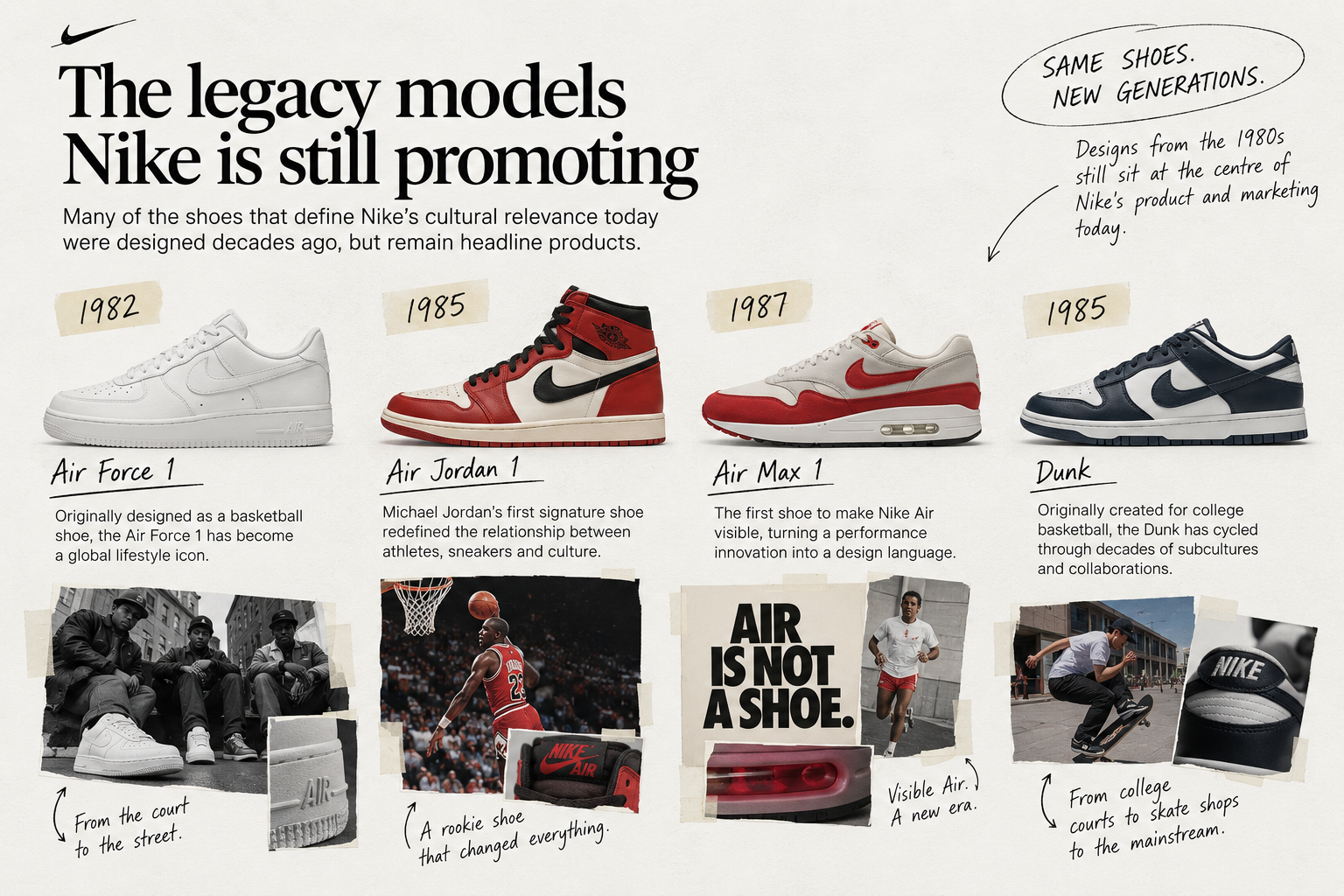
Nike's archive may be one of its greatest competitive advantages, but the danger comes when consumers become more excited about the return of a shoe from 1989 than the arrival of one designed in 2026. An over-reliance on legacy models and nostalgic moments allowed Nike to keep monetising the cultural relevance it had already built, without creating enough new reasons for the next generation to care. That's the first clue to how Nike stopped winning.
3. Nike's Innovation Problem
Now, the obvious response to all of this is that Nike hasn't stopped innovating. And that's true. This is still a company that spends enormous amounts of time and money trying to push the boundaries of sportswear. In recent years, Nike has developed everything from increasingly sophisticated carbon-plated running shoes to Nike Mind, footwear designed around sensory stimulation, and Project Amplify, a powered footwear system intended to make running and walking easier.
In this sense, Nike is still inventing things. But its more recent crop of products points towards a different problem: the best product innovations usually begin with a relatively simple human need.
Look at the brands that have gained ground around it. Hoka understood that runners wanted more cushioning and built an unmistakably oversized shoe around it. On Running created CloudTec and an equally recognisable visual language around the feeling of running on clouds. Salomon took decades of expertise in trail running and outdoor performance and found a new audience that wanted technical products for everyday life. Each brand gave consumers something new, but also something they could immediately understand.
Nike Mind makes for an interesting comparison. After more than a decade of research, Nike developed footwear containing 22 independent foam nodes designed to stimulate sensory receptors in the feet, with the aim of helping athletes feel more present and focused. Technically, it is an extraordinary proposition. But it also requires quite a lot of explaining.
Hoka's proposition can be understood almost immediately: more cushioning. On promised the feeling of running on clouds. Salomon offered technical outdoor performance for everyday life. Nike Mind asks consumers to understand why stimulating sensory receptors under their feet might improve the connection between their mind and body.
This is what makes Nike's innovation problem more complicated than simply saying it stopped making new things. Nike was still capable of producing impressive technology. Its competitors were becoming better at turning changing consumer behaviour into products people wanted.
For much of Nike's history, consumer demand and product innovation seemed inextricably connected. Founding partner Bill Bowerman experimented with his waffle iron because he wanted to give runners better traction. Air solved a performance problem and then became a visible design language. Flyknit responded to a desire for lighter footwear with less waste. Vaporfly emerged from an attempt to make elite distance runners meaningfully faster. The technology mattered because the benefit to the athlete was clear.
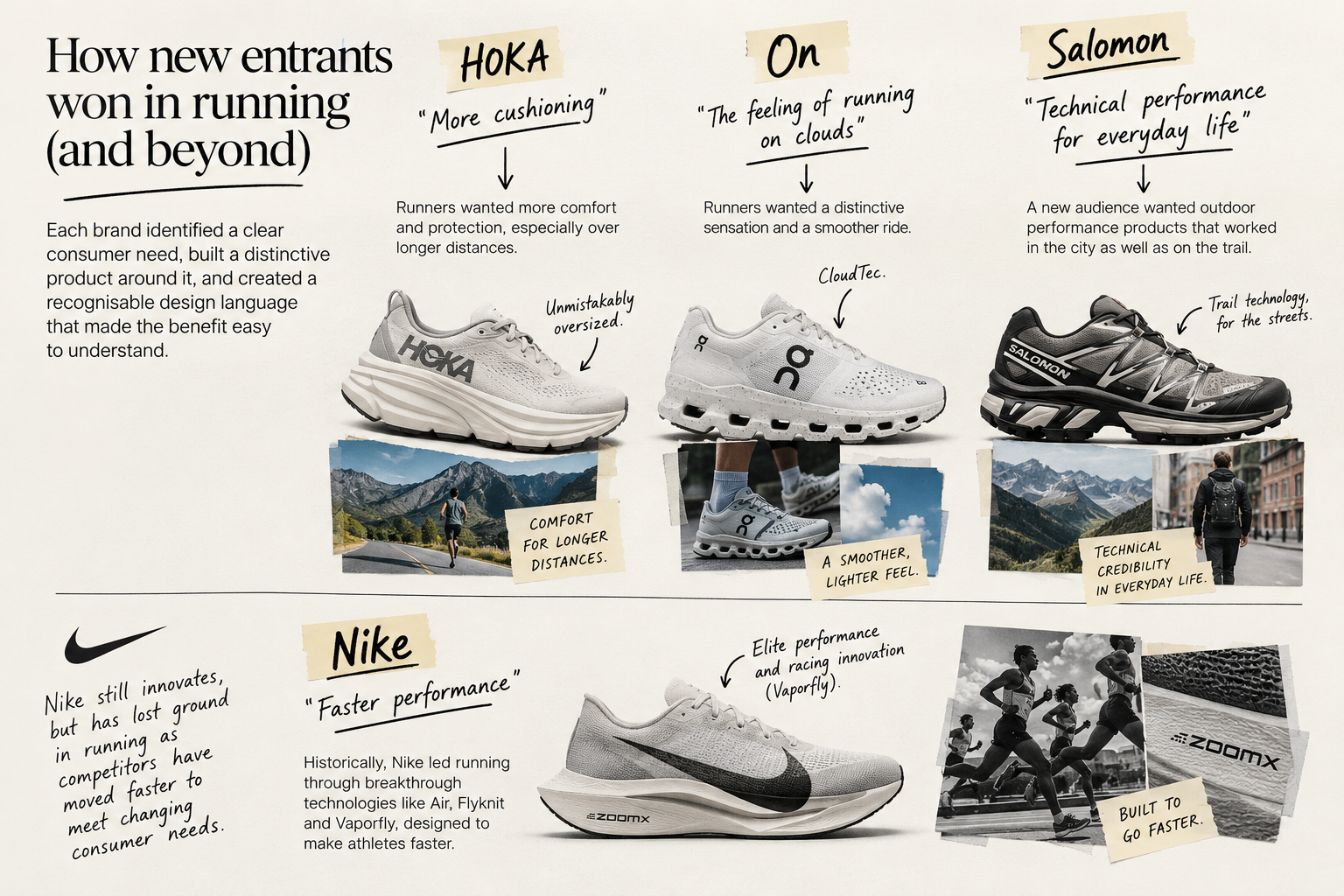
Over time, some of Nike's challengers began behaving more like the Nike of old. They focused obsessively on particular sports and communities, developed distinctive products around their needs, and allowed those products to earn credibility from the ground up. Nike's scale, once one of its greatest advantages, could also make that kind of intimacy harder. In China, for example, Nike is now moving towards more locally tailored product development after losing significant ground to faster-moving domestic competitors.
But that response also tells us something about what had gone wrong. Nike had not lost the ability to make technically sophisticated products. It had lost some of the connection between what it could make and what people actually wanted it to make.
And while Nike was trying to rediscover that connection, its competitors were gaining something else that would prove incredibly valuable.
Shelf space.
4. Nike Underestimated the Power of Retail
Nike wasn't only changing what it sold. It was also changing where it sold it.
For decades, Nike had relied on retailers like Foot Locker, JD Sports and thousands of independent running and sports stores to put its products in front of consumers. But by the late 2010s, the company increasingly saw those retailers as middlemen standing between the brand and its customers.
In 2017, under CEO Mark Parker, Nike launched its Consumer Direct Offense. One of its three central pillars was literally called “2X Direct.” Nike told investors that direct channels were more productive and profitable, noting that Nike.com generated nearly twice the revenue per transaction and significantly higher margins. Why sell a £150 pair of trainers through someone else's store and share the margin when Nike could sell the same pair directly through Nike.com or its own stores, while owning the customer relationship in the process?
Then John Donahoe became CEO in January 2020, and Nike accelerated the strategy substantially. In June 2020 it announced Consumer Direct Acceleration, explicitly saying the future marketplace would be led by Nike Digital and Nike-owned stores, alongside a more selective group of strategic partners. Donahoe reorganised the company around that strategy and described it as the company's next phase of growth.
On paper, the logic was compelling. Nike began prioritising direct-to-consumer sales, investing heavily in its apps, membership programme and digital storefronts while reducing its dependence on wholesale partners. When the pandemic arrived and consumers suddenly shifted online, the strategy appeared to have been vindicated. Digital sales surged. Nike had seemingly glimpsed the future of retail before everyone else.
But something important had been overlooked.
The store was never just a store.
At first glance, a wall of running shoes inside a retailer might just look like inventory. But it is also advertising. The person walking into a Foot Locker without knowing exactly what they want is discovering brands. The runner visiting a specialist store for advice is being introduced to products. The salesperson recommending a Hoka Clifton or On Cloudmonster instead of a Nike Pegasus is effectively doing marketing for that brand.
Every space Nike gave up created an opportunity for somebody else to take its place. And at precisely the moment Nike was pulling back from wholesale, a generation of competitors desperately needed physical distribution. Hoka needed runners to try its unusually oversized shoes. On needed people to experience CloudTec. Salomon needed consumers outside the trail-running world to encounter its products. New Balance and Asics were finding renewed cultural relevance. Retailers needed something to fill the space Nike was leaving behind, and these brands were ready.
The effect was bigger than simply losing sales through those stores. Nike was also giving competitors access to discovery. A consumer might walk into a shop intending to buy Nike and walk out wearing Hoka. Someone who had never heard of On could try a pair because a salesperson recommended them. Over thousands of stores and millions of interactions, shelf space became awareness, awareness became trial, and trial became habit.
There is an irony here too. Nike had spent decades understanding that distribution could create desire. Seeing Air Jordans on the feet of other kids at school mattered. Seeing Mercurials across a football pitch mattered. Seeing an entire wall of Nike shoes in a sports store mattered. Physical presence made the brand feel ubiquitous, and ubiquity reinforced its cultural power.
The mistake, then, wasn't building a direct-to-consumer business. Owning the customer relationship is enormously valuable, and Nike was right to invest in it. The mistake was treating direct and wholesale as though one could simply replace the other. Nike optimised for ownership of the transaction while underestimating the value of being discovered.
There is a broader lesson here. In an era obsessed with direct audiences, first-party data and measurable conversion, it is tempting to think every intermediary should be removed. But sometimes the intermediary is doing something that doesn't appear neatly in the margin calculation. Sometimes it is introducing you to your next customer. Nike didn't simply leave revenue on the shelves it abandoned.
It left attention there too.
5. Where is Nike’s next Michael Jordan?
Products and distribution only explain part of Nike's rise. The other part was people.
Nike has always understood that the right athlete can do something advertising alone cannot. Michael Jordan didn't simply sell basketball shoes. He gave Nike a character through which it could tell stories about greatness, competitiveness and possibility. The relationship worked in both directions. Nike helped transform Jordan into a global cultural icon, while Jordan helped transform Nike from a running company into something much bigger.
The same formula appeared repeatedly. Tiger Woods in golf. Andre Agassi and later Serena Williams in tennis. Kobe Bryant and LeBron James in basketball. Ronaldo Nazário and Cristiano Ronaldo in football. Nike became extraordinarily good at identifying athletes who could define an era and then building stories, products and sometimes entire businesses around them.
But look at that list again and another problem begins to emerge.
Michael Jordan is 63. Tiger Woods is 50. Kobe Bryant is no longer with us. Cristiano Ronaldo is 41. And now Kylian Mbappé, the footballer who appeared best positioned to inherit Ronaldo's place within Nike, has left for On after almost two decades with the company. More concerningly, Nike has also watched several other athletes who could define the next generation build their identities elsewhere. Lamine Yamal wore Nike before signing with Adidas as a teenager. Brazil star Endrick did the same before joining New Balance at 17. And in tennis, Coco Gauff has been with New Balance since she was 14, a relationship that has since grown into her own signature shoe and fashion collaborations with Miu Miu. The list goes on.
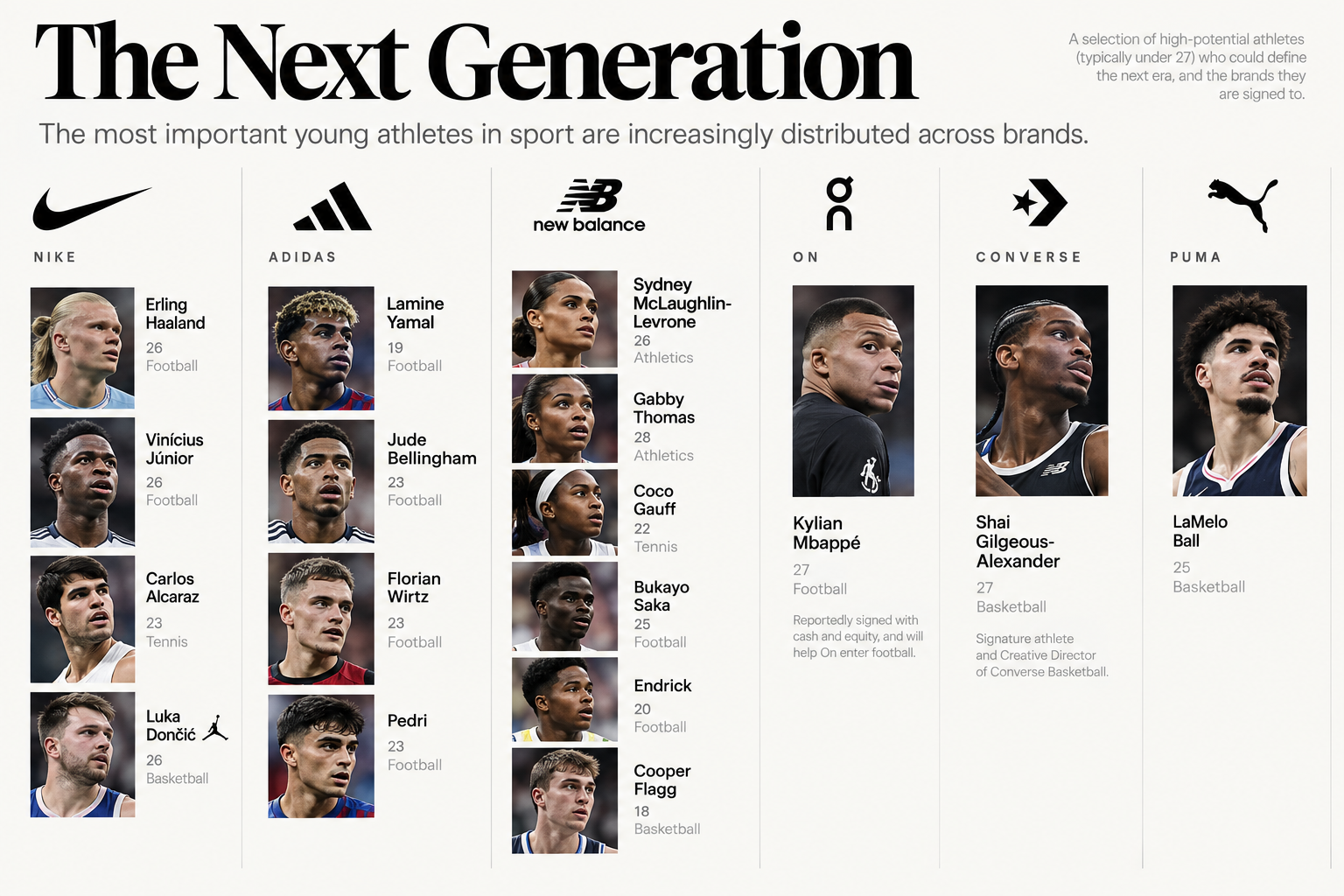
Returning to Mbappé, his new deal reportedly includes both cash and equity, making him not simply the face of On's entry into football, but someone with a financial stake in what the company is trying to build as On plans its entry into the football boot market in 2027. That last detail matters because it shows how the relationship between athletes and brands is changing too.
The traditional endorsement model was built for an era in which brands owned distribution. Nike had the advertising budget, the retail relationships and the cultural machinery capable of taking a great athlete and making them globally famous. The athlete provided the performance. Nike provided the megaphone.
Today's athletes increasingly arrive with their own platforms. They communicate directly with millions of followers, build their own media companies and brands, and can turn attention into businesses without waiting for a sportswear company to do it for them. For the most valuable athletes, simply being paid to wear somebody else's product may therefore become less compelling than having the opportunity to help build something they partly own.
In some ways, On may be offering Mbappé something closer to what Nike offered Michael Jordan in 1984 than what Nike could offer Mbappé in 2026. Not literally. Jordan's original Nike deal wasn't structured like a modern equity partnership. But philosophically, the proposition is surprisingly similar: a challenger brand entering new territory, an extraordinary athlete at the centre of it, and an opportunity to build something together rather than simply advertise something that already exists.
And On isn't alone. Across the industry, the relationship is beginning to evolve from athlete as billboard to athlete as partner. Shai Gilgeous-Alexander is the Creative Director of Converse Basketball and has helped create his own signature product. New Balance has built signature products and collections around Coco Gauff and Sydney McLaughlin-Levrone. Puma's relationship with A$AP Rocky extends beyond advertising into designing products and shaping the brand's presence across fashion, music and football culture.
Nike itself understands some of this. Through Jordan Brand and Converse, it has experimented with deeper athlete relationships, while its own roster still contains some of the most extraordinary young athletes in the world: Erling Haaland, Vinícius Júnior, Carlos Alcaraz and Luka Dončić among them.
So while Nike is still signing some of the best athletes in the world, the playing field is more distributed than ever. And perhaps more importantly - the question is whether Nike can still turn great athletes into something bigger than an endorsement deal.
With that in mind, perhaps the harder question isn't just where is Nike’s next Michael Jordan?
It is whether another Michael Jordan can exist at all.
Jordan emerged during an era of unusually concentrated attention. Millions of people watched the same television channels, saw the same commercials, read the same magazines and watched the same highlights. When Jordan did something extraordinary, enormous parts of culture experienced it together. Nike could place one athlete at the centre of that system and build a mythology around him that travelled around the world.
Pop culture doesn't work like that anymore. Attention has fragmented across sports, creators, communities, platforms and algorithms. A basketball player can be enormously influential without being known by everyone. A runner can become a cultural icon within running. A women's footballer can command a global audience of her own. The internet has created more stars, but arguably fewer universally shared icons.
As such, perhaps Nike's challenge isn't to find one new Michael Jordan. It may be to build a new kind of athlete portfolio for a fragmented cultural landscape. The original Nike athlete machine was built around a relatively simple idea: identify the people who might define the future of sport before everyone else does, then help make them bigger. That principle still works.
What has changed is what a star looks like, how their influence travels, and what they expect from the brands that want to come along for the ride.
6. Nike started harvesting what Nike had built
Taken individually, each of Nike's decisions made sense.
Selling more Dunks and Air Force 1s made sense because consumers wanted them. Moving customers from Foot Locker to Nike.com made sense because Nike could capture more margin and own the relationship. Investing in digital advertising made sense because the results could be measured. Building campaigns around established athletes and franchises made sense because their popularity was already proven.
The problem appears when you put all of those decisions together.
Nike had spent decades accumulating an extraordinary amount of brand equity. The Swoosh meant something. Air Jordan meant something. Air Max meant something. Just Do It meant something. Millions of people around the world already wanted Nike products before the company showed them an advert or sent them an email. That created an enormous opportunity to extract value from demand Nike had already created.
And increasingly, Nike became very good at doing exactly that.
A retro release could be forecast using decades of existing demand. Moving a customer from a wholesale partner to Nike.com could immediately improve the economics of a transaction. Performance marketing could tell Nike how much revenue an advertising campaign generated. Membership could turn an anonymous customer into a measurable one. The business became increasingly sophisticated at capturing, quantifying, converting and monetising the attention surrounding Nike.
But the things that originally created that attention were much harder to measure.
What was the immediate return on signing an unproven 21-year-old Michael Jordan in 1984? How do you calculate the ROI of putting visible Air inside the sole of a shoe when nobody had asked for it? What was the conversion rate on Just Do It? How do you put a number against the cultural value of Ronaldo wearing silver, blue and yellow Mercurials at the 1998 World Cup?
Today, those decisions look obvious because we already know what they became.
At the time, they were bets.
And this is one of the great tensions inside any successful brand. Brand equity creation and brand equity extraction are not the same thing.
Extraction is usually easier to measure. It asks: how do we sell more efficiently to the people who already want us?
Creation asks a much more uncertain question: what can we do today that will make somebody want us ten years from now?
The first question leads naturally towards optimisation. Better conversion rates. More revenue. Higher margins. More customer data. More efficient media. More versions of products that already sell.
The second can lead somewhere much stranger. An experimental shoe. An unknown athlete. A film that doesn't immediately sell anything. A small running community in a city that isn't yet commercially important. A product that initially looks ridiculous. A designer, musician or footballer whose influence isn't obvious on a spreadsheet yet.
Some of those bets will fail.
But historically, the ones that worked became Nike.
Perhaps that is the thread connecting so many of the problems we've explored. Nike didn't stop innovating. It didn't stop signing athletes. It didn't stop making great advertising or investing in retail. But as the company became larger, more sophisticated and more accountable to the enormous business it had already created, it became increasingly tempting to optimise the assets whose value was already visible.
The irony is that Nike's competitors could afford to do the opposite.
Hoka has to convince people that unusually thick running shoes are desirable. On has to create a new visual language for running. New Balance has to find a new generation of athletes and cultural collaborators. Smaller brands cannot simply harvest decades of cultural relevance because they don’t have decades of cultural relevance to harvest to begin with.
They have to create it.
And in doing so, some of them are starting to behave a lot like the Nike that Nike itself once was.
That doesn't mean a company should ignore efficiency, margins or the products people already love. Great businesses need to extract value from the equity they have created. Nike would be foolish not to sell another Air Force 1 simply because the shoe was designed in 1982. The danger comes when extraction begins to outpace creation. Brand equity behaves a little like a reservoir. You can draw from it for an extraordinarily long time, particularly when the reservoir is as deep as Nike’s.
But eventually, you have to put something back in.
And that, ultimately, may be the simplest explanation for how Nike stopped winning.
7. Can Nike become Nike again?
The good news for Nike is that it appears to understand much of what went wrong.
In October 2024, Elliott Hill returned as CEO after spending more than three decades at the company. Since then, Nike has begun rebuilding wholesale relationships, reorganising around individual sports, reducing its reliance on established lifestyle franchises and putting renewed emphasis on performance innovation, particularly in running.
There are early signs of progress. In Nike's 2026 financial year, wholesale revenue grew 6 percent while Nike Direct fell 6 percent, reflecting some of that shift back towards a more balanced marketplace. But the wider business remains under pressure, with annual revenue of $46.4 billion and continued weakness in markets including China. The harder part of Nike's recovery, however, cannot be solved through restructuring alone.
Rebuilding a relationship with Foot Locker is relatively straightforward. Creating the next Air Max isn't. Reducing the number of Dunks in the market can happen in a few seasons. Finding the athlete who might define the next twenty years could take much longer. Nike spent decades building a system capable of repeatedly producing things the world hadn't seen before. The real test of its turnaround is whether it can build that system again.
8. What Nike teaches us about building brands
Nike's story contains a lesson for any successful brand.
Success creates assets. Products people recognise. Customers who already want you. Distribution. Cultural relevance. Intellectual property. An archive. And naturally, businesses become increasingly sophisticated at extracting value from those assets.
But the things that extract brand equity are not necessarily the things that create it. Performance marketing can capture existing demand. It cannot guarantee future desire. Direct-to-consumer can increase the value of a transaction. It cannot replace discovery. Heritage can give a brand meaning, but it cannot become a substitute for invention. And signing somebody who is already culturally relevant isn't the same as identifying and helping create the person who defines what comes next.
Great brands need both.
They need to harvest the equity they have already created while continuously planting the seeds of whatever comes next.
And the difficult part is that those seeds are often the least measurable investments a company makes. The strange product nobody asked for. The unknown athlete. The small community. The ambitious film. The idea that doesn't immediately convert into revenue.
Nike became Nike by making generations of people imagine what they could become. Somewhere along the way, it became increasingly good at reminding them what Nike used to be.
The challenge now isn't simply to make Michael Jordan relevant again or find another colourway for a shoe designed forty years ago.
It's to create the products, athletes, stories and ideas that a teenager today will be nostalgic for forty years from now.
Nike needs to show us the future again.


