

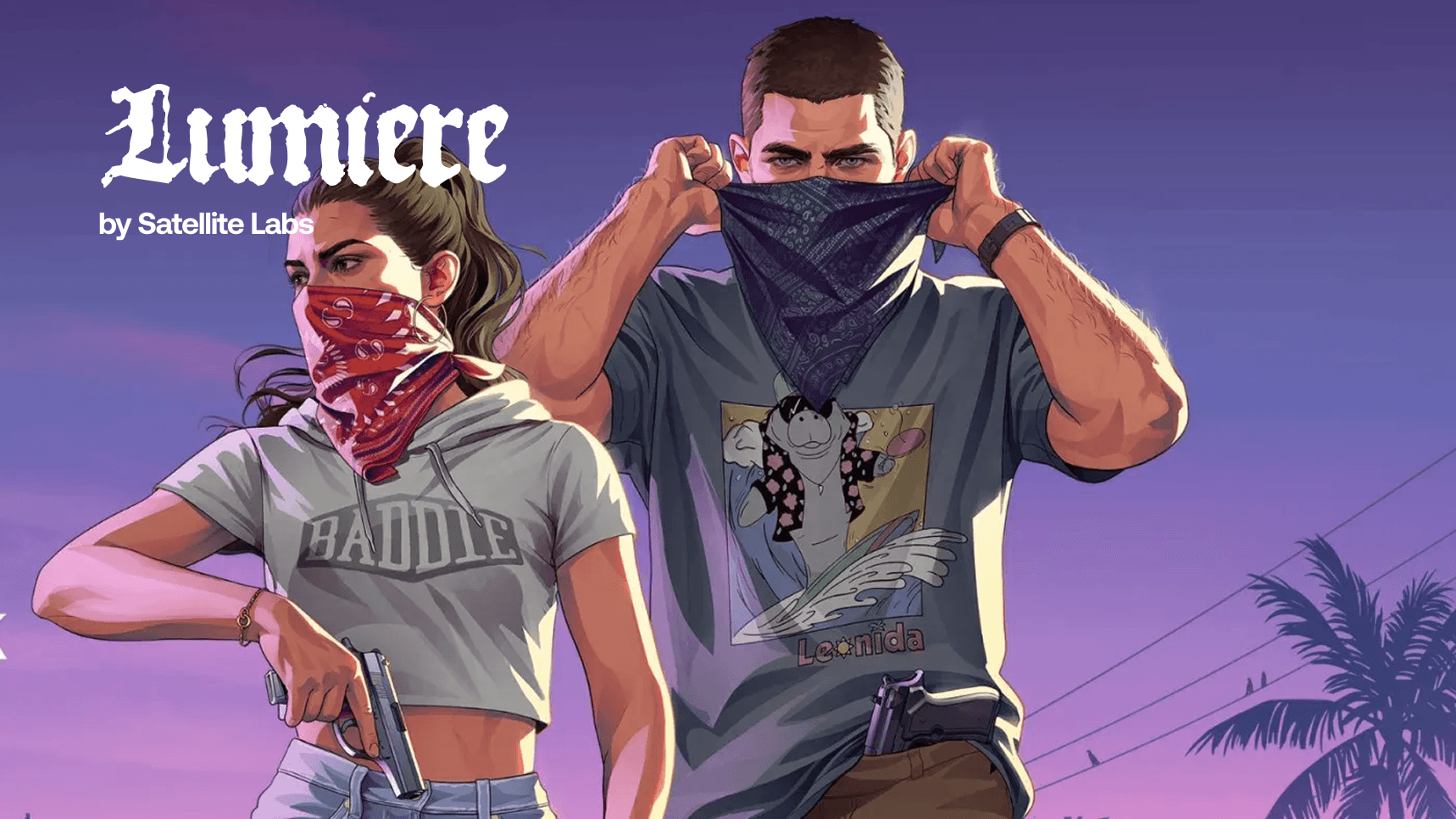
Millions of people can describe a city that has never been built. They know its neighbourhoods, its radio stations, its hierarchies of money and status. They can name corners of Los Santos with the same casual confidence someone else reserves for a real postcode. Los Angeles may have inspired the place, but Los Santos has developed an identity of its own.
Over the past three decades, Rockstar Games has created fictional versions of America that hundreds of millions of people have come to know and love. From the streets of Liberty City to the beaches of Vice City, these worlds have become recognisable cultural landmarks in their own right. And with the arrival of Grand Theft Auto VI, thirteen years after its predecessor, we've been thinking about what makes these games so extraordinary, and what their success might teach us about how we build brands and businesses.
The numbers alone are groundbreaking. Grand Theft Auto V has sold into distribution more than 230 million copies worldwide, making it one of the most commercially successful entertainment products ever created. Its successor has already set another record, reporting an estimated $3.79 billion in worldwide retail sales on its first day. For context, that is more than the entire lifetime global box office of almost every film ever made, achieved in a single day. Of course, retail sales and box office receipts are different measures, but the scale of the achievement is difficult to ignore.
How does a creative business build something capable of generating this level of demand?
And what can the rest of us learn from it?
1. Building a world takes a village
One of the things we find most interesting about Grand Theft Auto is the sheer number of disciplines involved in bringing it to life.
In our everyday understanding of the creative industries, we tend to separate them into individual categories. Film studios produce movies, fashion houses design clothing, record labels release music, architects design spaces and technology companies build software. Yet Rockstar manages to bring all of these disciplines together within a single product. And remarkably, the result feels like one cohesive experience.
Consider what it takes to create a city like Los Santos. There are writers developing characters and dialogue, architects and environmental artists designing streets and buildings, graphic designers creating fictional advertisements, musicians composing and curating soundtracks, and engineers developing the technology that brings everything together. Each discipline contributes something essential to the atmosphere and identity of the world.
The music is a particularly interesting example. Over the years, Rockstar has collaborated with artists and DJs including Frank Ocean, Flying Lotus, Solomun and Tale Of Us, giving them opportunities to bring their own musical identities into the fictional universe. Frank Ocean's blonded Los Santos radio station, for example, brought his distinctive approach to music curation into the game. GTA Online's nightclub experiences went further, placing internationally recognised DJs within a virtual nightlife scene.
These are remarkable collaborations when we consider the cultural reach of the people involved. Rockstar has effectively created a platform where music, fashion, storytelling and technology can coexist, allowing specialists from different industries to contribute to something much larger than their individual work.
And perhaps this is where the first lesson lies. Great creative work often emerges when we bring together people who are exceptionally good at different things, give them a shared vision, and allow their expertise to shape the final experience.
What if we approached branding like an open world game?
When we talk about branding, the conversation tends to begin with visual identity. Logos, colours, typography, websites and the various elements that give a company its recognisable appearance. These are important foundations, but they represent only a fraction of how people actually experience a business.
Think about the number of interactions we have with a company over the course of our relationship with it. We might encounter an advertisement, browse a website, visit a physical store, purchase a product, receive a package, speak with customer service or attend an event. Each of these moments contributes to our understanding of the business, and each provides an opportunity to communicate something about what that company stands for.
Yet many organisations approach these experiences as separate activities. The website is commissioned from one team, the advertising from another, the identity from a third, while the physical experience and customer service develop under entirely different departments.
Now imagine if Rockstar built Grand Theft Auto in the same way. A beautifully designed city with music that feels completely out of place. Characters whose personalities have little relationship with their surroundings. Advertisements that bear no connection to the fictional culture. We might still have an impressive collection of creative assets, but the experience would lose much of what makes it believable.
We think there's an opportunity for businesses to approach branding with the same ambition that Rockstar brings to building an open world game. To think about every interaction as part of a larger environment, where the visual identity, product, technology, communications and physical experiences all contribute to a shared narrative.
And crucially, to bring the best people we can find into each of these disciplines.
This feels particularly relevant as artificial intelligence makes creative production more accessible. Today, we can generate imagery, produce videos, build software and develop digital experiences at a fraction of their historical cost. That's an extraordinary opportunity, especially for smaller companies with limited resources. But the quality of the tools available to us makes creative judgement, cultural understanding and the ability to bring different disciplines together even more important.
We have an opportunity to build things that previously required the resources of much larger organisations. The question is whether we can develop the taste, ambition and collaborative practices necessary to make use of it.
Culture is an ingredient
There's another aspect of Rockstar's approach worth examining. Its fictional worlds are deeply informed by the real cultures from which they emerge.
Grand Theft Auto has always been a kind of exaggerated portrait of American life. Its stories draw from consumerism, celebrity, wealth, crime, politics and the endless contradictions of modern society. Its fictional businesses parody real industries, its radio stations reflect musical movements, and its characters often resemble personalities we recognise from popular culture.
GTA VI continues this tradition through Vice City and the wider state of Leonida, drawing heavily from the architecture, music, nightlife and unusual social phenomena associated with Florida. Even the early trailers reference viral moments and incidents that have circulated across the internet. Rockstar pays extraordinary attention to the world around it, then finds ways to translate those observations into something recognisable and entertaining.
And the relationship works in both directions. Over time, Grand Theft Auto has become so culturally familiar that people use it to describe the real world. A chaotic public incident becomes something straight out of GTA. For years, the internet joked about increasingly improbable events happening before GTA VI, turning the game's eventual release into a cultural reference point of its own.
This offers another lesson for how we approach creative work. Culture provides an enormous source of inspiration, and the people who understand it most deeply are often those participating in it. By collaborating with musicians, artists, designers and communities, businesses can create experiences that feel connected to the world their audiences actually inhabit.
The best ideas rarely emerge from working in isolation. They come from paying attention, developing relationships and bringing different perspectives into the creative process.
The economics of world building
There's also a compelling economic argument for this approach, particularly as companies face increasing competition for consumer attention.
Over the past decade, we've witnessed an enormous expansion in the amount of content businesses produce. Social platforms have made distribution more accessible, while generative AI is rapidly reducing the cost of production. We can now create and publish more material than at almost any point in human history.
But as the supply of content increases, attention becomes more competitive. Producing another advertisement, video or campaign becomes less valuable when thousands of other companies can do the same thing at a similar cost.
Rockstar's success provides an interesting perspective on the value of investing in something that people genuinely want to return to.
When the first GTA VI trailer appeared in December 2023, it attracted more than 93 million views on YouTube within twenty-four hours. Fans analysed individual frames, compared locations with their real world equivalents, debated characters and created an enormous amount of commentary. All of this activity contributed to the wider anticipation surrounding the game.
Of course, Rockstar invests heavily in marketing, and its position has been built through decades of commercial success. But it also possesses something that makes those investments considerably more effective: an audience that already cared.
That relationship has substantial economic value.
For the last thirteen years, Grand Theft Auto V has continued generating revenue through game sales, GTA Online and recurring consumer spending. The fictional world has provided a foundation for additional content, digital goods, subscriptions and new experiences, allowing Rockstar to continue monetising an asset long after its initial release.
This is an important part of the economics of intellectual property. Developing a world of this complexity requires enormous upfront investment in creative talent, technology and production. Once established, however, that intellectual property can support multiple revenue streams over time. Existing audiences can reduce the cost of attracting customers to future releases, while shared technology, creative assets and brand recognition can create economies of scope across different products.
There are risks, of course. Development costs can be substantial, creative projects can fail, and cultural relevance is never guaranteed. A large audience also brings high expectations that future releases must meet. GTA VI's reported retail sales tell us about demand, but they don't tell us the full development cost or the profit Rockstar will ultimately earn.
Still, the underlying principle is worth considering. We can invest in creative work that generates attention for a few weeks, or we can invest in assets that have the potential to create value for years.
We might describe the latter as a form of cultural equity. The accumulated value of distinctive products, memorable experiences and relationships that people continue engaging with over time.
For businesses, cultural equity can lead to stronger customer loyalty, more organic recommendations, greater pricing power and opportunities to enter new markets. And when these advantages reinforce one another, they can become a meaningful source of competitive advantage.
Building something people want to be part of
We believe there's a broader opportunity here for the creative industries.
As the boundaries between design, technology, entertainment and commerce continue to overlap, businesses have an opportunity to become more ambitious about the experiences they create. A fashion company can build a world through its products, campaigns, stores, collaborations and community. A hospitality business can combine architecture, food, music and service into an experience that people want to return to. A technology company can build platforms that allow its customers to create experiences and businesses of their own.
What connects these examples is the idea that a company can be understood as a collection of interconnected experiences, held together by a shared identity and creative vision.
It requires us to think beyond individual campaigns and transactions, and to consider how the different parts of a business work together. It also requires a willingness to collaborate with people whose expertise and perspectives are different from our own.
This is where Rockstar's approach becomes particularly interesting. Through its work with artists, musicians, designers, writers and engineers, the company has created fictional worlds that continue developing meaning through the people who inhabit them.
In GTA Online, players have formed communities, built fictional businesses, organised events and developed entire stories through roleplaying. The creative work continues long after the original product has been released, as audiences discover new ways to participate in what Rockstar has built.
And that might be the greatest commercial achievement of all. A product that gives people enough freedom, meaning and value to keep returning, even when the company has relatively little new to announce.
As we look towards the future of branding and creative business, perhaps we should be thinking more like world builders. Thinking about the complete experience, bringing together exceptional people across different disciplines, and investing in things that can develop meaning and value over time.
Because when we build something people genuinely care about, we create the possibility of something much greater than a successful launch or a memorable campaign.
We create the foundations for a world that people can make their own.


