

For the better part of the last fifty years, we've been on a mission to digitise the world around us.
We've digitised our communications. Our finances. Our relationships. We've built software to manage our customers, track our operations, measure our performance and optimise almost every conceivable aspect of modern business.
And by most measures, we've been remarkably successful.
Today, companies have access to more information than at any other point in history. We can track customer behaviour in real time. Measure the performance of campaigns down to individual clicks. Monitor the movement of money, goods and people across entire continents.
We have dashboards for everything.
And yet, despite all this progress, something rather strange remains.
An extraordinary amount of work still depends on people moving information from one place to another.
A customer raises a complaint. Someone logs it in a system. Another person reviews it. An email is sent. A meeting is arranged. A decision is made. And eventually, someone gets around to doing something about it. We've become exceptionally good at recording what happens inside our businesses. Where we are lagging perhaps, is in our ability to respond to it.
Perhaps this points to something rather interesting about the way we've built modern companies. And more importantly, how we might begin to build them differently.
The problem isn't a lack of technology
If we take a look at the average business today, we'll find a sophisticated collection of tools.
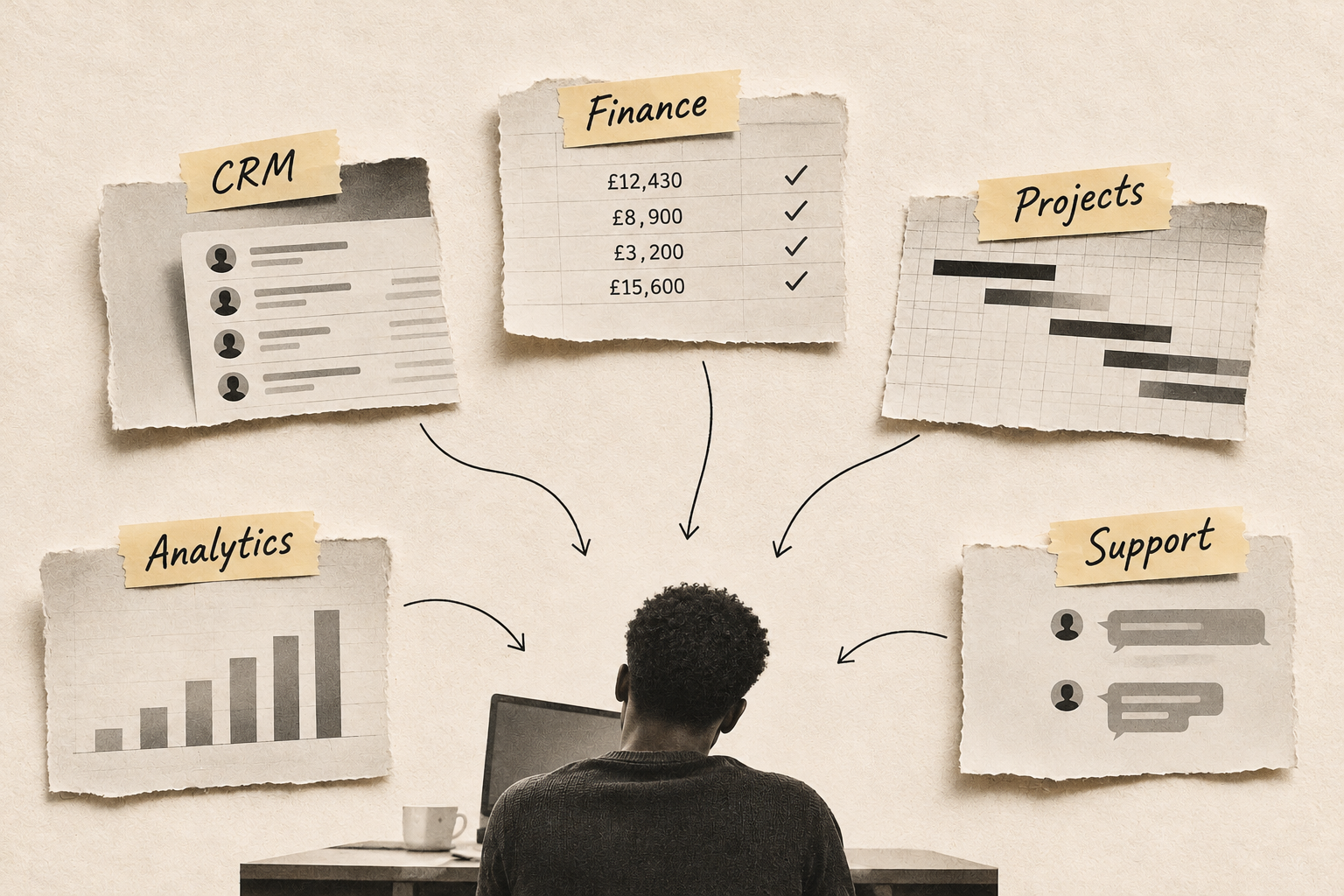
A CRM to manage customers. An accounting platform to manage finances. Project management software to coordinate teams. Analytics platforms to measure growth. Communication tools to keep everyone connected. Each one serves a purpose. Each one makes a particular part of the business more efficient. But there's one sneaky little problem:
Most of these systems were developed independently, and they don't really understand one another.
The CRM knows what the customer purchased. The finance system knows whether they've paid. The operations team knows whether the product has been delivered. And the customer service team knows whether they're happy.
But who connects all these pieces of information?
Usually, people!
We employ people to gather information, interpret it, pass it along, make decisions and coordinate the actions that follow. In many ways, this is what much of modern management has become. The coordination of information across an increasingly complicated collection of systems. And while technology has made each individual activity easier, it hasn't necessarily made the organisation as a whole more intelligent quite yet. Perhaps it is this opportunity, to rethink the emergent intelligence that can come out of our organisational systems, that will unlock the next generation of value drivers for companies around the world.
From information to intelligence
For most of the digital age, software has been something that people operate.
We open an application. Navigate an interface. Enter information. Retrieve a report. Make a decision. And then move to another application to do something about it. The software provides the tools. The human provides the intelligence. However it is clear that this relationship is beginning to evolve. With the emergence of increasingly capable artificial intelligence, we're beginning to build software that can do more than store information and follow predetermined instructions. It can interpret context. Identify patterns. Work through problems. Use other software. And, within defined boundaries, take action - through agents.
Consider a relatively ordinary situation.
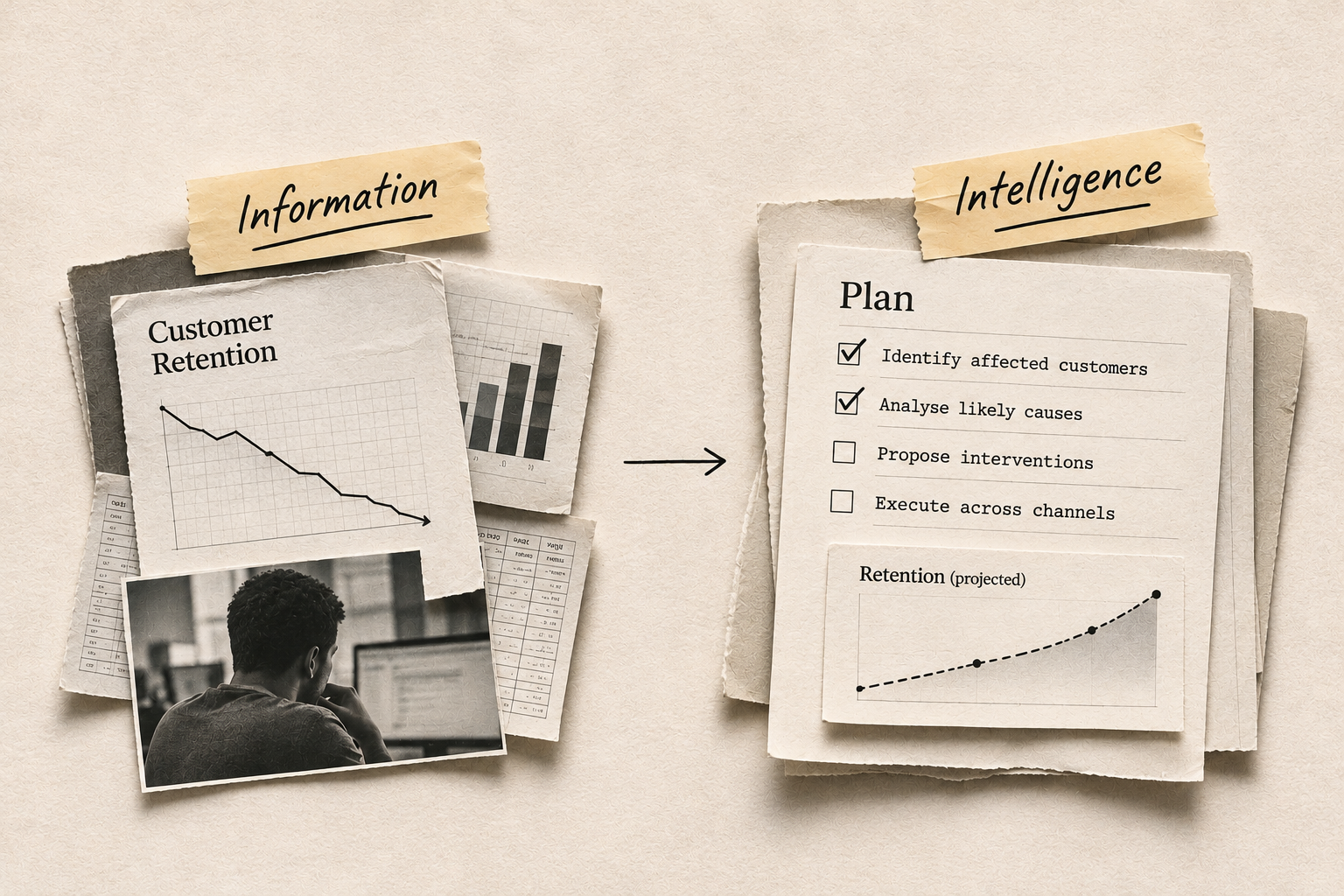
A company notices that customer retention has declined.
Today, that information might appear in a dashboard. Someone in the marketing team investigates. They speak to customer service. They review recent purchases. They prepare a report. A meeting follows, and eventually a plan is agreed.
Now imagine a different scenario.
The system identifies the decline, examines customer behaviour, compares it with previous periods and highlights possible causes. It identifies which customers are most affected, proposes potential interventions and prepares the necessary actions for approval. Once approved, those actions can be carried out across the relevant systems, with the results monitored over time.
The people involved haven't disappeared. They're still responsible for judgement, direction and accountability. But much of the work required to move from information to action has been reduced. This is the promise of what is increasingly being called agentic AI. Software that can work towards an objective, rather than simply respond to individual commands.
And we think its implications extend far beyond making existing tasks more efficient.
A different way to think about the company
For centuries, we've organised companies around people, departments and responsibilities.
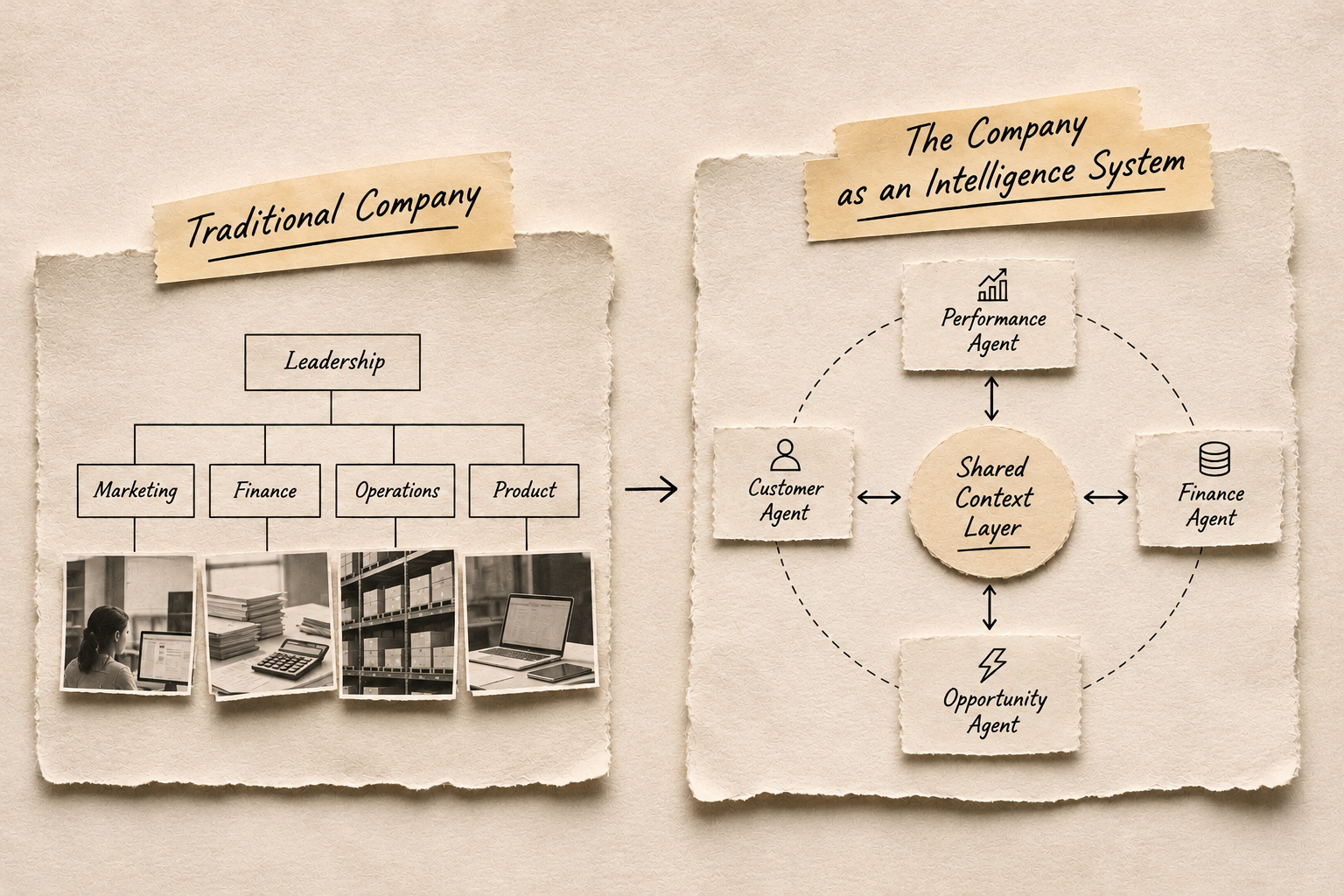
We divide work into functions. Finance manages money. Marketing manages demand. Operations manages delivery. Leadership coordinates the whole thing. As companies grow, we introduce more processes, more management structures and more software to hold everything together. This inevitably leads to bloat, administrative complexity, red tape - and increasing degrees of separation between the company's staff and the end consumer. Stagnation, plateau and eventual decline inevitably follows before a new entrant disrupts the incumbent sleeping giant.
But what if we approached the problem from a different perspective?
What if, rather than thinking about a company primarily as a collection of departments, we began to think about it as an intelligence system? A system that observes what's happening around it. Understands its environment. Makes decisions. Takes action. And learns from the results. In truth, companies have always operated this way to some extent. The intelligence has simply been distributed across the people, processes and technologies that make up the organisation.
What's changing is our ability to connect that intelligence.
Imagine a shared context layer that brings together a company's information, objectives, workflows and operational tools.
Within that environment, AI agents could help coordinate work across different functions. One might monitor operational performance. Another might investigate customer issues. Another might prepare financial forecasts or identify emerging commercial opportunities.
Each would operate with access to relevant information, clear responsibilities and defined limits on what it could do. The technical infrastructure that makes this possible is sometimes called a harness. Essentially, the environment that gives AI systems the context, tools, permissions and safeguards they need to work reliably; an infrastructure that takes what was once a disparate set of systems that required manual maintenance, into a contextual environment that can increasingly and seamlessly inform coordinated action.
The next competitive advantage
We suspect this shift will change what makes one company more capable than another.
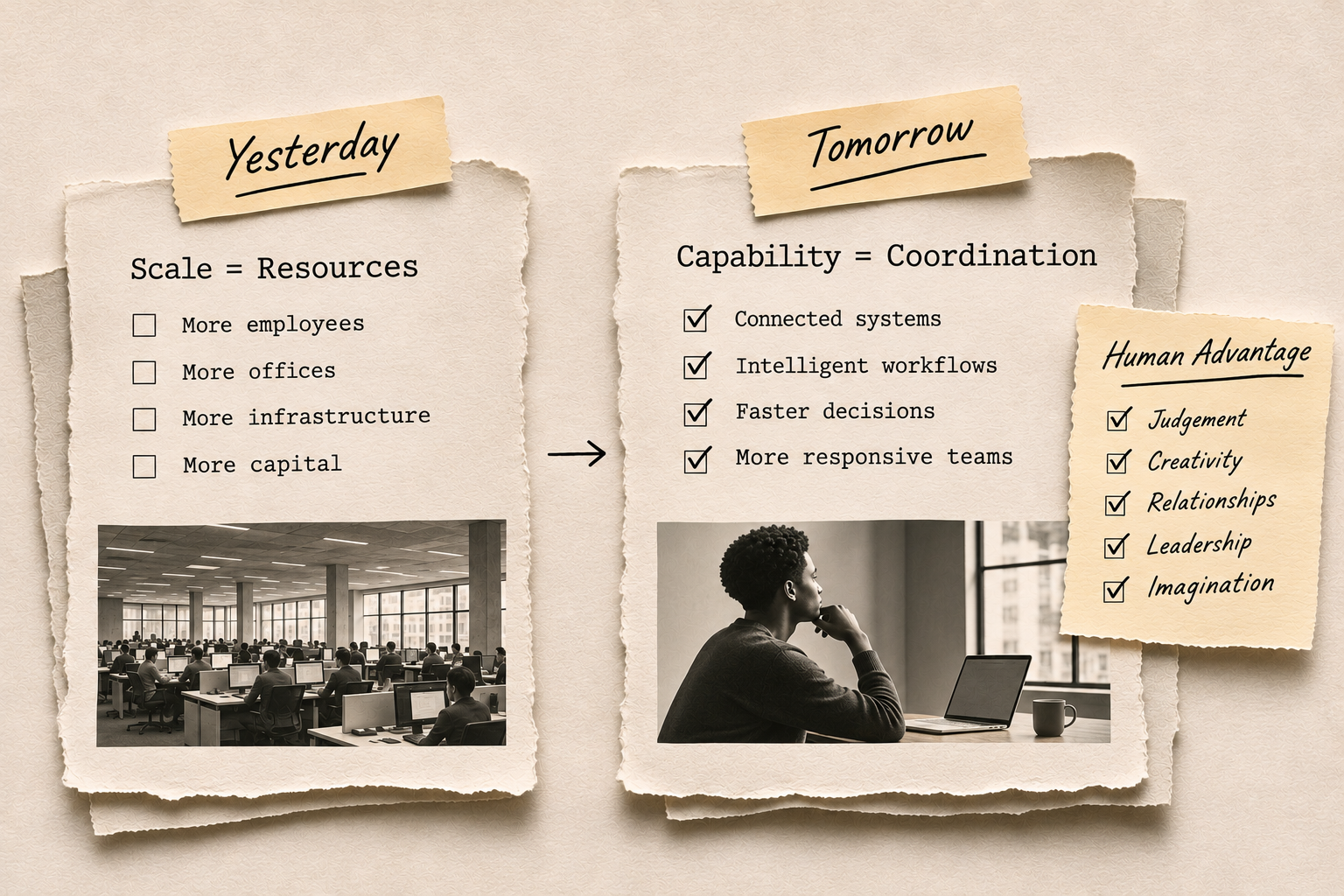
For much of the last century, scale has been closely associated with resources. More employees. More offices. More infrastructure. More capital. And while those things will continue to matter, they may become less reliable indicators of what an organisation is capable of achieving.
A smaller business with well connected systems and carefully designed workflows could potentially coordinate activities that once required much larger teams. A larger organisation might become more responsive by reducing the time between identifying a problem and acting upon it.
But none of this happens simply by purchasing an AI subscription, or even a series of stand alone tools. It requires businesses to understand where their knowledge lives, how decisions are made, which processes create unnecessary friction and where intelligent systems can genuinely improve outcomes.
It also requires time, care and craft.
AI systems make mistakes. They can misunderstand information and take inappropriate actions. The more responsibility we give them, the more important it becomes to establish clear boundaries, oversight and accountability. And this oversight and direction can only be the role of humans. Our objective should not be to remove people from companies. It should be to free our people to focus on the things that make their contributions most valuable, so that they can do the best work of their lives too.
Judgement. Creativity. Relationship building Leadership. The ability to imagine something that doesn't yet exist. These are where people really and truly excel. All of the other noise should be abstracted away to our machines to handle on our behalf.
The opportunity ahead
We're entering a particularly interesting period in the history of business.
We've spent decades digitising the activities of our organisations. Building the tools, databases and networks that allow modern companies to function. But perhaps that was only the first chapter.
The next may be about connecting those systems in ways that allow organisations to become more responsive, more capable and more intelligent. Rather than simply using artificial intelligence as a displacement layer and stopping there, future businesses will be designed around the effective combination of human and machine intelligence - and it will multiply the impact that companies can have by orders of magnitude.
If we get this right, the implications could be considerable.
Smaller teams capable of doing bigger things. Established businesses able to move with greater speed. People spending less time coordinating processes and more time creating value. We may find that the most important question for the next generation of business leaders isn't which new software they should introduce.
It's how they should rethink the company itself.
Because the company of the future may not simply contain intelligence.
It may be designed to operate through it.


